Thursday, August 21, 2014

Daniel and Peter

Everything happens for a reason.

Last year I twisted my ankle on the first day I was in Galway, Ireland. I was scheduled to climb Croag Patrick (see pic below) the next morning, but when I put my foot down to stand up, I knew my plans would have to change. I would not be climbing mountains any time soon.

Big disapointment, yes. End of the world? No. I was in Ireland, and there are NO bad days in Ireland, twisted ankle or not.

So I adjusted my plans and spent the day hobbling about the streets of Galway, taking a ferry out to the Aran Islands, and taking pictures of the sheep who so graciously give up their coats to make the beautiful Aran sweaters everyone loves. I still ended up climbing up a few hills and over the rocky Burren....even strolled through open farmland.

Now back to my opening statement - everything happens for a reason.

That night I sought out a pub that was said to have the best Irish music in town. I got there early and found a great spot at the bar, right below the suspended stage. My toes were itching to tap, I didn't want to miss one minute of Irish culture, and local pubs are one of the best places to be doused. As I was waiting to be noticed by the barmaid, an arm shot out next to me to collect two beers that were sitting on the bar. I must have made a face (I had been sitting there waiting for quite some time) and suddenly I heard the voice next to me (in a sweet Irish lilt) "Oh apologies...did I jump ahead of you?"

I turned and found myself looking at the smiling face of an Irishman. Adorable. That was my first thought. This guy is absolutely adorable. Young, fresh and with manners. And he was obviously concerned that I hadn't been waited on, so he said "No worries...I'll take care of that straight away."...and he did.

That was my first introduction to Daniel and Peter, two young Irishmen from Belfast, who were on holiday in Galway. They invited me to join them at their table and the rest is history. We spent the next few days tooling around the streets of Galway, enjoying the people watching and having an overall great time. Through their colorful stories, I learned much about the culture of Northern Ireland, an area of I really had very little knowledge of, apart from the "Troubles" of the 60's and 70's. 

That was a year ago, and since then, through the age of modern social media, we've become fast friends. Which is why, when they invited me to visit their beautiful country (Northern Ireland is still considered Ireland, but is a part of the United Kingdom) - I enthusiastically agreed. 

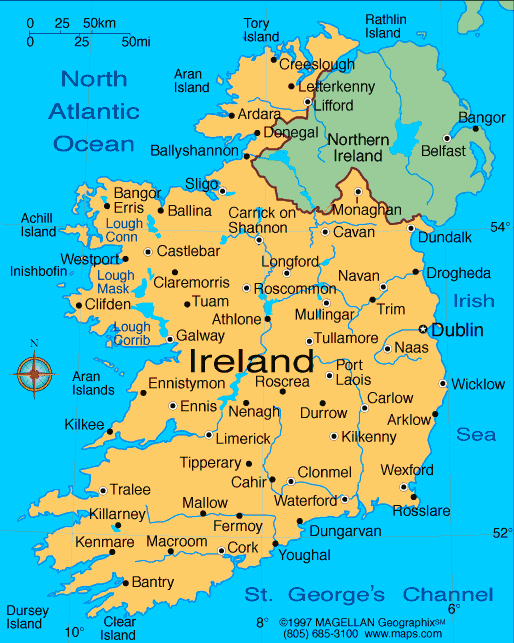
So today I journey to Ireland, and will land in Dublin, where they will "collect" me, and we will drive back up to Belfast. In looking at the map of Ireland, this should be a beautiful drive. And a wonderful chance for us to catch up on a year of activity in all of our lives. Once in Belfast, we will spend the next few days exploring this beautiful area. In Daniel's words - 

". . . we will visit Dunluce castle and take a Bushmills whiskey tour as they are in the same area. The Titanic museum perhaps? It's 10 minutes away as it's the city centre. You might like to tour the jail used during the troubles. Crumlin road Gaol it's called. Some hikes I thought you might like are Cave HIll or the Mourne Mountains in Co. Down. Giant's Causeway and Cerrick A Rede rope bridge for sure. And of course a night out with live Irish music in Belfast. ...."

I will also have the absolute honor to visit Daniel's parents on their farm in Co. Sligo, which is in the Republic of Ireland. According to Daniel, his father is quite the historian on the troubles of Ireland. 

I am sure there is nothing better than seeing Ireland through Irish eyes.

My journey will then take me, finally, to the mountain I was going to climb last year. I'll bus on my own to Co. Mayo where I will spend a few days, and it's there I will hopefully, finally check this mountain climb off my bucket list. 

From there I will head back to Dublin, where I will get to spend a few days with my dear friend Nancy, her husband Finbarr, and their son Tadhg. I've not seen them in a few years so I'm really looking forward to that reunion. Nancy and I've been known to hit a few pubs together and I doubt this trip will be any exception.

So yes, things happen for a reason. If I had not twisted my ankle that first day in Ireland, I would never have met Daniel and Peter. So, as they say in Ireland..."And there you go, Bob's your uncle." (meaning, there you have it.)

I'll be blogging along the way over the next week or so, and I'll hope you join me. I'll do my best to take you right along on the journey through words and pictures.

Slainte! 
Giant's Causeway

Cerrick-a-rede rope bridge

Croag Patrick
Peter and Daniel


Wednesday, March 19, 2014

The Cliffs of Moher


My bucket list is one item shorter than it was a year ago. 

I finally stood on the edge of Ireland. I visited the Cliffs of Moher and managed not to fall off. 

You've seen the pictures. Any calendar or book of Ireland worth it's salt will have at least one panoramic view of the Cliffs of Moher. These cliffs are beyond description but I'm going to try my best to take you with me. Just don't get too close to the edge. 


The cliffs are located on the west coast of Ireland in Co. Clare. At their highest point, the cliffs stretch over 700 feet above the Atlantic Ocean. That's 70 floors. Think: A few floors shy of the John Hancock Building in Chicago. They get their name from an old fort called Moher, that was once part of the cliffs in the mid 18th century. 

One of the first things you notice when visiting the cliffs is the lack of barriers on the edge. It's almost creepy to stand on the edge, knowing that with one good gust of wind, a person could easily become fish food. And through the years, this has happened. Or so I'm told. There are many signs warning visitors to stay back from the edge...


...but go figure...here I am about 8 inches from the edge I was warned about.  I couldn't resist.

In the middle of the cliffs there is a stone tower called "O'Brien's Tower" that was built in 1835 by Sir Cornelius O'Brien. If you climb the tower you can actually look out into the Pacific and see the Aran Islands in Galway Bay.


Have you ever heard of a Puffin? Neither had I, until I visited the cliffs. The Atlantic Puffins are birds that resemble adorable stuffed animals. They live in large colonies along the cliffs. 

For you movie buffs, the cliffs have been featured in several movies through the years, but they are most reconizable in The Princess Bride, Harry Potter and the Half-Blood Prince, and Leap Year.

If you are looking for one more thing to add to your bucket list, I highly recommend you add a visit to the cliffs. I can honestly say that standing on the edge of Ireland was one of the most memorable moments of my life. 

The Story of the Claddagh


The claddagh is a very familiar symbol found on all kinds of Celtic souveniers, especially jewelry. There is symbolism to the claddagh,  and a sweet, romantic story behind it. 

It all started about 300 years ago in the small fishing village of Claddagh, just outside the town of Galway, on the west coast of Ireland. According to legend, a fishing boat from the village was captured by pirates and the crew was taken and sold into slavery. One young lad, who was scheduled to be married that very week, was sold to a Turkish Gold Smith. During his years in captivity, he never stopped loving his girl back in the village. He crafted a ring of gold for her. After many years, he earned his freedom and returned home to the village of Claddagh, where he found his young love waiting for him. She had never given up hope that they he would return to her. He gave her the ring, and they were married, never to be separated ever again.

Sigh.

The symbols on a claddagh are the heart in the center (symbolizing love), two hands (friendship) and a crown (loyalty). 

If you have a claddagh ring, take care of how you wear it. In Ireland, there is a particular way to wear this ring and they take this very seriously. How you wear the ring indicates your relationship status.

If worn on the right hand with the heart pointing toward the fingertips, this indicates the wearer is single and looking for love. 

Worn on the right hand with the heart pointing toward the wrist, the wearer is in a relationship, or, their heart is captured.

Worn on the left hand, with the heart pointing toward the fingertips, the wearer is engaged to be married. And worn on the left hand with the heart pointing toward the wrist, the wearer is married. Forever bound in love, friendship and loyalty. 

You are Blessed indeed if you enjoy a relationship with all three; love, friendship and loyalty. 

I leave you with a few photos I took in the village of Claddagh this past summer. 

Slainte! 
The fishing village of Claddagh


Thursday, January 31, 2013

Celebrating the Bard


Robert Burns
Right now, Scots and descendents of Scots around the world are donning their finest kilts, raising a glass and cutting into a steaming hot haggis in celebration of the 259th birthday of Scotland’s favorite son, Robert Burns. (Or if you are Scottish…”favourite son Rabbie Burns”).

Why the celebration

Great question. Pull up a chair and a wee dram (that’s a glass of whiskey to you non-Celts) and prepare to be entertained and impressed.

Affectionately referred to as “Rabbie” by those who hold him in great esteem yet have never met him, Robert Burns (1759-1796) is one of the most beloved people of Scotland – in fact, he is so well loved by his countrymen and women that he was chosen as the Greatest Scot in a vote on Scottish television in 2009.  Not bad for a man who’s been dead for over 200 years.

Robert Burns was, first and foremost a Scot and a patriot. But what he’s best known for is his contribution as a bard. In the days of yore, a bard was a man who made his living as a poet. Yep, a bard was the guy you see in old pictures sitting at the feet of the King, waxing poetic on how great he is and how wonderful his legacy will be. But that wasn’t exactly how it played out for Rabbie.

In his short life Burns penned or had a part, in penning over 800 poems and songs. And should you think he had no impact on your life, think again. Chances are you’ve sung at least the first verse of Auld Lang Syne at the stroke of midnight on New Year's Eve. Burns penned the song that is sung by New Year’s revelers around the globe.  Auld Lang Syne is also listed in the Guinness Book of World Records as one of the three most popular songs in the English language, just in case you were wondering.

An Interesting Life

Every writer needs a muse - someone or something that inspires them to put pen to paper. In the case of Rabbie Burns, you don’t have to look too hard at his life to see where his inspiration came from. His reputation as a ladies man is well documented by his own hand. And the fact that he was loved by the ladies is probably one of the reasons he’s so admired by men today. 

Or so I’m told by men today.

But in this area he was also his own worst enemy, leaving a string of broken hearts, broken promises, and 12 children in his wake. In fact, his love life reads like a snarky romance novel: Falls in love on a farm, has an affair with a servant while embarking on a relationship with another gal. Both become pregnant at the same time, one with twins. He eventually marries the mother of the twins, but eventually falls in love with another gal he spotted while at a church service. From there he has a relationship with a separated woman, before moving on to her servant girl.

And those are just the ones we know about.

It could be argued that the problems in his love life could be laid at the doorstep of his childhood. He grew up in poverty and hardship, a manual laborer on a farm. And as all good stories go, he also met his first love down on the farm. And from that first love, came his first attempt at poetry, “O, Once I Lov’d A Bonnie Lass.”

There are anecdotes around his writing that have been passed down through the centuries that help us better understand the heart and spirit of Burns.


“There’s a story of him writing Tam O’ Shanter in one afternoon. He asked his brother Gilbert to work the farm and in one afternoon he wrote the best poem in history. Gilbert heard Robert laughing loudly as he sat at the banks of the river Nith. He put all he has learned in life into the story, liars, whores, warlocks, witches, ghosts and goblins, the devil...it is by far the greatest poem that was ever written.” - Dougie Smith, Falkirk
His writings also have inspired other writers. The novel, “The Catcher in the Rye” was based on the poem, “Comin’ Thro the rye,” and the title of “Of Mice and Men” was taken from Burns’ poem, “To a Mouse.”

Celebrating Burns at a Burns Supper

So, back to the celebrations I mentioned. “Burns Suppers” are held around the world and most all of them, from Edinburgh to Dunedin, Florida – follow the same basic format. For the sake of space I won't include everything that happens at a Burns Supper. But here are a few highlights - I think you will get the picture. 

Usually a Burns Supper starts with a general welcome and announcements, followed with Selkirk Grace:
Some hae meat and canna eat,
And some wad eat that want it,
But we hae meat and we can eat,
Sae let the Lord be thankit.

(I failed to mention that Burns wrote in the language of the time: Auld Scot. Don't even try to understand it. I'm convinced this is the reason they serve Scotch at dinner...) 
Translated:
Some have food and cannot eat,
And some would eat that lack it,
But we have food and we can eat,
So let God be thanked.

After the grace comes the piping (as in bagpipes) and cutting of the haggis. And to me, this is the best time of the night. Because if you are lucky, you will have someone with a very thick Scottish brogue give Burns's famous, “Address to the Haggis.”  

Fair fa' your honest, sonsie face,
Great chieftain o' the puddin-race!
Aboon them a' ye tak your place,
Painch, tripe, or thairm:
Weel are ye wordy o' a grace
As lang's my arm.

(Needless to say there's more but in the interest of time, space and understanding, I suggest you google the Address to the Haggis. And you'll need a translator for sure.)


Then the haggis is cut open and served. It actually tastes better than it looks, really. Think ground beef with a bit of a liver flavor. Okay, it tastes better than it sounds as well. 


At the Burns Supper’s I’ve attended, there is then the “Salute to the Lassies,” given by a man. And then the response by the women, “Salute to the Laddies.” Both or these are typically tongue-in-cheek addresses, cynical and endearing all at the same time.


I'm forever fascinated by the rich depth of Scottish history and tradition.

Robert Burns is just one of the many Scottish contributions to world culture for which we should all be grateful. And I'm proud of those who are of Scottish descent who work hard to carry the stories and traditions forward so that coming generations never forget from whence they came.

Let them all be thankit.


Other Interesting Burns Facts
  • There are more than 50 memorials dedicated to Robert Burns around the world. Excluding religious figures, only Queen Victoria and Christopher Columbus have more dedicated statues.
  • Burns’ skull was bigger than the average man’s. After he died and was buried in St. Michael's Churchyard in Dumfries in 1796, Rabbie’s body was exhumed in 1815 to be placed in a new mausoleum in the town. While the body was above ground, a plaster cast was taken of his skull for study and measured. Forensic experts also recreated a 3D depiction of his face for a STV documentary.
  •  Through his twelve children, Burns has over 600 living descendents today.